


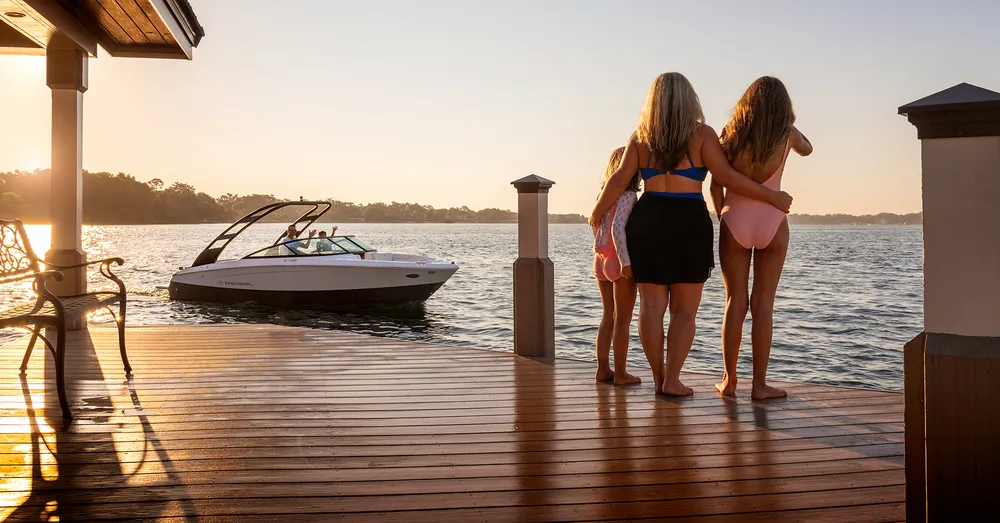
Executing a precise close-quarters approach when wind vectors are pushing your hull off axis is the definitive test of a captain's seamanship. Across Southeast Texas waterways—whether navigating the high-density marina basins of Lake Conroe or maneuvering near exposed bulkhead restaurants—sudden crosswinds can instantly compromise your entry line. Failing to account for atmospheric drift leads to frantic throttle over-corrections, severed mooring lines, and expensive fiberglass gelcoat fractures.
Managing an elite Malibu Wakesetter, Axis tournament boat, or a luxury Regal runabout in heavy air requires trading panic for mechanical discipline, leveraging pulse throttle control, and utilizing the wind's energy rather than fighting it.
The Fundamental Axiom: Velocity Eliminates Control
The single most common handling error executed during a high-wind approach is carrying excessive forward momentum into the slip perimeter. Captains often come in too fast out of fear that the wind will catch the bow, leaving them with zero reaction time when a timber piling or concrete bulkhead looms close.
- The Slow-Motion Baseline: Approach the terminal structure exclusively at a velocity that allows you to instantly arrest all forward momentum with a brief pulse of reverse throttle. If you feel rushed at the helm, your entry speed is fundamentally too fast.
- Open-Water Staging Logistics: Complete 100% of your rigging preparation well outside the active channel. Deploy your high-impact marine fenders early (on both sides if you are uncertain of your landing angle) and flake your double-braided nylon dock lines cleanly on deck so they are entirely free of knots before your final approach. Assign specific crew roles—one specialized line handler at the beam and one alert spotter watching the dock edge.
The Phased "Triangle Approach" Matrix
Break down your docking strategy into three distinct technical phases to ensure absolute predictability from open water to the tie-up.
- Phase 1: Establish the Entry Vector: Align your bow at an angle heading slightly into the prevailing wind or current vector. Crabbing into the environmental force allows your hull to track a straight line toward your target destination rather than being swept downstream.
- Phase 2: Neutral De-Acceleration: Disengage the binnacle detent and shift into neutral early, allowing the vessel’s natural hydrodynamic drag to reduce your momentum. Let the boat glide smoothly toward the pier rather than pushing it with active engine RPM.
- Phase 3: Micro-Pulse Corrections: Execute steering adjustments utilizing brief, one-second clicks of power—shifting into forward idle to correct the bow axis, then instantly dropping back into neutral. Docking is an exercise in managed drifting; continuous throttle application near a bulkhead destroys your physical mechanical advantage.
Tactical Weather Adaptations for Lake Conroe Channels
Your approach geometry must shift completely based on how the wind vector intersects the face of the terminal structure.
- Scenario A: Wind Pushing the Vessel Away From the Dock
- The Strategy: Approach the dock at a steeper, more aggressive angle. Aim your bow directly at the center of your target landing zone. The crosswind will naturally act as a brake, slowing your momentum. Once the bow is within close proximity, cut the helm hard away from the pier and pulse the throttle into reverse to swing the stern parallel, allowing the wind to gently settle your beam against the structure.
- Scenario B: Wind Driving the Vessel Into the Dock
- The Strategy: Approach the structure at a flatter, nearly parallel angle. Bring the vessel to a complete stop a few feet outside the active slip perimeter using a brief pulse of reverse gear. Put the transmission in neutral and let the crosswind drift your hull sideways onto the pier, allowing your pre-staged fenders to absorb the final impact smoothly.
- Scenario C: Navigating Covered or Open Marina Slips
- The Strategy: Plan your structural rotation much earlier than you would on a calm afternoon. A late turn forces the helm into aggressive throttle bursts to prevent side-slipping, which can cause the stern to break loose and collide with neighboring slips or support beams.
Hydrodynamic Buffer and Fender Placement Strategy
Standard bumper layouts often fail in high winds because the cylindrical cushions are hung uniformly without considering hull rotation.
- The Mid-Ship Insurance Asset: Position your largest, thickest fender directly at the beam’s widest point of maximum displacement. This serves as your primary pivot point and safeguards your gelcoat if the hull rolls unexpectedly under a sudden wind gust.
- Stern Swing Compensation: If crosswinds are catching your superstructure, add an auxiliary fender toward the aft quarter of the transom. Inboard tournament boats and dayboats naturally swing their sterns aggressively when executing a reverse check, making low-end quarter protection mandatory.
The Controlled Abort Command
There is zero penalty for abandoning a compromised approach line. If a sudden rogue wake from a passing watercraft hits your hull at a bad angle, or if your bow ceases to respond to helm inputs due to a heavy gust, immediately execute an abort sequence.
- Clear the Bulkhead: Do not attempt to force a bad angle by applying forward power near a piling. Shift cleanly into reverse, back out into open water, and re-establish your entry axis. A calm, calculated reset is the definitive mark of an experienced mariner.
Technical Frequently Asked Questions
Should my passengers leap onto the dock to secure the lines during a windy approach?
No. Enforce a strict mandate that all passengers remain securely seated in their assigned zones until the hull is completely stationary and secure against the wood or concrete pier. A missed approach can easily be corrected with a short pulse of reverse throttle; a rushed leap between a wet bulkhead and a multi-ton hull poses an immediate, severe safety hazard.
What is the most efficient way to sharpen my high-wind docking skills?
Navigate to an isolated courtesy dock or around an empty floating mooring buoy during quiet, low-traffic weekday mornings. Execute repeatable, disciplined approaches from multiple angles to analyze exactly how your specific hull and propulsion configuration drifts under different wind loads.
Sourcing Factory-Authorized Control & Rigging Support
If your vessel experiences sluggish steering responsiveness, or if your mechanical binnacle requires excessive physical effort to find the neutral detent, you may be fighting an equipment deficiency rather than a lack of environmental skill.
- Certified Steering and Throttle Calibration: Over time, hydraulic steering systems can contract and develop internal air pockets, and mechanical shift cables can stretch or bind inside their support tubes. Schedule an automotive-level diagnostic checkup with our factory-certified technicians at the SMG Boats Service Center department to restore instantaneous control response. To submit a specialized maintenance request directly, access our online Service Form.
- Premium Parts and Rigging Elements: Visit our comprehensive Parts Center to secure high-tensile, double-braided nylon mooring lines, customized ground tackle, heavy-walled cylindrical fenders, and specialized quick-release fender clips built to handle immense tension.
- Propulsion System Modernization: For owners looking to update an older platform with responsive low-end torque or advanced digital control networks for absolute precision near the trailer bunks, check our specialized Yamaha Outboards line.
Fleet Allocation and Financial Coordination
What structural credit frameworks exist for financing a premium watercraft purchase or overhaul?
Our specialized Financing office provides tailored loan configurations, allowing you to seamlessly bundle your choice of high-performance modern hull, reliable outboards, technical electronics, and localized Marine Insurance packages into a single structured framework. You can calculate precise capital trajectories using our digital Payment Calculator.
Can I leverage my current watercraft as trade equity to fund an upgrade this season?
Yes. We coordinate transparent, market-accurate asset evaluations through our internal Sell Your Boat division, making it highly efficient to liquidate your old hull and apply that value directly toward our premier inventory of Malibu Wakesetters, Axis tournament boats, and Regal luxury bowriders. Explore our current selection of New Boats or thoroughly inspected Used Boats.
How do I track upcoming dealer events or connect with SMG Boats?
To monitor safe-boating seminars, captain safety workshops, and regional consumer rendezvous across our South Texas hubs, check our active Events calendar. To review long-term mechanical protection parameters, consult our Extended Service Contracts checklist. For maps, showroom directions, and operational hours across all our regional dealer hubs, visit our primary Contact Us portal or locate our facilities directly via our Locations directory.